If you’ve gone to grab rat bait at Bunnings or your local supermarket lately and found the shelf half empty, you’re not imagining it. The rules around rodent bait in Australia changed in March 2026, and it’s already affecting what Sydney homeowners can buy, what pest controllers can do, and how rodent problems need to be managed going forward.
Here’s a plain-English explanation of what happened, why it happened, and what it actually means for your home.

What’s Actually Changed
In March 2026, the Australian Pesticides and Veterinary Medicines Authority (APVMA), the body that regulates pesticides in Australia, moved to restrict a group of rat baits called Second Generation Anticoagulant Rodenticides, or SGARs.
Two things happened in quick succession. On 12 March 2026, the APVMA certified that SGARs should become Restricted Chemical Products, meaning professional and licensed use only. Then on 24 March 2026, it suspended the registration of every SGAR product for 12 months as an interim measure while the longer-term regulatory change is worked through.
In plain terms: the strong rat baits that used to sit on the shelf next to the fly spray are being pulled from general retail sale over 12 months. The five active ingredients caught up in this are brodifacoum, bromadiolone, difenacoum, difethialone and flocoumafen. If you flip over an old box of bait in the shed, there is a good chance you will see one of those names.
Why the Rules Changed
To understand why the law changed, it helps to understand why SGARs became the industry standard in the first place.
First Generation Anticoagulant Rodenticides, FGARs, have been around since the 1940s. They work by preventing blood clotting, but they require rodents to feed multiple times over several days before a lethal dose accumulates. That gave rodent populations time to develop bait shyness, where animals learn to associate a particular bait with illness and avoid it. Resistance built up over decades.
SGARs were developed to solve that problem. They are far more potent, lethal after a single feed, and rodents don’t develop the same resistance. For commercial pest control, they were a significant improvement. They worked reliably, they worked fast, and they became the backbone of rodent control programs across Australia.
The problem is what happens beyond the target animal.
When a rat or mouse dies from an SGAR, the compound stays biologically active in its tissue for weeks. Any animal that then eats that carcass, a native owl, a hawk, a kookaburra, a possum, or a family dog or cat, absorbs the same compound. SGARs are anticoagulants, meaning they cause internal bleeding. Vitamin K is the antidote for anticoagulant poisoning, but by the time symptoms appear in a non-target animal, the internal damage is often already advanced and treatment is intensive.
Research published in 2023 found that approximately 92% of nocturnal raptors sampled across south-eastern Australia had detectable SGAR residues in their liver tissue, with around 80% of barn owls showing concentrations associated with lethal or sublethal effects. The Animal Poisons Helpline’s 2024-2025 report showed that 1 in 3 pet poisoning cases related to rodenticides involved SGARs.
That accumulation of evidence is what finally drove the APVMA to act.
What It Means for You
If you have relied on store-bought bait to deal with rat or mouse problems, that option is narrowing significantly. The products being withdrawn are the ones that actually worked at a DIY level. What remains on the shelf is first-generation chemistry, slower acting, requiring multiple feeds, and increasingly subject to resistance in urban rodent populations.
For a genuine infestation, DIY baiting was already limited. Research suggests DIY baiting removes around 40% of a rodent population on average, with infestations typically returning within two to four weeks if entry points and food sources haven’t been addressed. Without the stronger products, that figure will be lower still.
This is where most people, including a lot of property managers and small business owners, are going to get caught out. The 2026 changes didn’t just restrict which products are available. They introduced specific operational rules around how rodent baiting must be carried out.
Here is what has changed.
- No outdoor baiting for mice at all. Outdoor bait stations are now for rats only. If your problem is mice, baiting happens indoors, in the garage, the feed shed, enclosed roof voids, or non-toxic trapping is used outside. This is the rule almost nobody knows about yet.
- All outdoor bait must be inside a tamper-resistant, weather-resistant station, secured in place. Loose bait, bait on a tray, bait tucked under a sheet of tin, all non-compliant outdoors. The station is mandatory, full stop.
- Anywhere accessible to pets, children or non-target animals requires a tamper-resistant station. A chicken coop is, by definition, accessible to non-target animals. Around a coop or a feed shed the station is required regardless of how sheltered the spot feels.
- Stations must be positioned no more than two metres from a building. A fence line twenty metres out in the paddock is no longer a compliant placement location.
- Bait cannot be placed directly into burrows.
- Baiting cannot run continuously for more than 35 days without stopping to assess. If bait is still being taken after five weeks, the answer is to reassess the infestation and what is driving it, not to keep refilling without review.
- At every check, dead rodents must be searched for and removed. Gloves are required when handling bait, stations and carcasses. Dead rodents left lying around are how owls, kookaburras, dogs and cats get secondarily poisoned. This is not optional, it is a compliance requirement.
These rules apply to licensed pest controllers as well as anyone attempting DIY control with whatever products remain available. For professionals, there is also a documentation requirement: written risk assessments before treatment and detailed records of bait placement, quantities and activity findings at each visit.
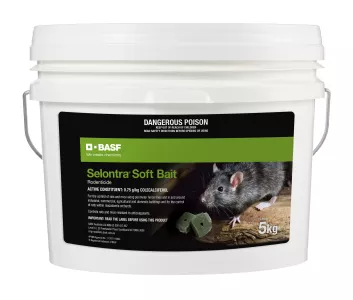
The Bait We Use, Selontra
At So Pest Off, the bait we use across Sydney is Selontra. It’s a professional product made by BASF, and we chose it for two straightforward reasons: it works better than anticoagulant baits, and it is significantly more wildlife-friendly.
Selontra’s active ingredient is cholecalciferol, a naturally occurring form of Vitamin D3, and it is not an anticoagulant. It works by disrupting calcium regulation in rodents rather than interfering with blood clotting. Because it is not an SGAR, it sits entirely outside the APVMA suspension. It is a Schedule 7 product, professional use only, and you will not find it on a supermarket shelf.
On performance, Selontra controls rodents up to three times faster than anticoagulant rodenticides. It has a stop-feed effect, meaning affected rodents stop feeding on bait and non-bait food sources shortly after consuming a lethal dose. That reduces the number of treatments required, minimises bait wastage and reduces the risk of contamination from foraging rodents. The formulation is stable and palatable across both hot and cold conditions, effective against strains of rats and mice that have developed resistance to conventional anticoagulants, and formulated as pale-green soft blocks placed inside tamper-resistant lockable stations.
On wildlife safety, the active ingredient is neither persistent nor bioaccumulative. It breaks down rapidly in the environment and does not build up in animal tissue the way anticoagulant rodenticides do. This gives Selontra a significantly lower secondary poisoning profile, a reduced risk of avian toxicity and a reduced contamination risk to the surrounding environment compared to both first and second generation anticoagulants. Dead rodents that have consumed Selontra carry far less risk to scavenging birds, predators and pets than those killed by SGARs.
We use it as part of a managed monthly program: in tamper-resistant lockable stations, fixed to compliance specifications, with activity recorded and carcasses removed at every visit.
Why We Only Service Ongoing Programs
Because of how these products now work and what the regulations require, we only take on rodent baiting for clients on a regular maintenance program. No one-off jobs.
That is partly a supply issue, professional-grade compliant stock is genuinely difficult to source right now, and we have secured enough to look after our program clients and a limited number of new ones. But it is also simply the right approach.
The 35-day reassessment requirement means someone needs to visit, check activity, refill or adjust bait, collect carcasses and document everything, every month. That is a program, not a one-off service. One-off baiting with no follow-up is exactly the model the new regulations are designed to move away from.
For commercial sites, restaurants especially, but also warehouses, logistics operations and any business under food safety audit, we build a custom program around the specific demands of the site. Our Bluetooth-monitored bait stations log rodent movement in real time between visits, giving us the data to proof the real entry points rather than guessing, and providing the timestamped activity records that HACCP and food safety auditors will ask for.
Read more about our rodent proofing and why this service is becoming more popular
Frequently Asked Questions
Can I still buy rat bait at the supermarket in Australia?
The strongest baits, Second Generation Anticoagulant Rodenticides, are being withdrawn from general retail sale following the APVMA’s March 2026 decision. Some milder products may still be available, but the heavy-duty baits people relied on are being phased out over 12 months. For a serious rodent problem, a licensed pest controller is now the reliable option.
Why were rat baits restricted in Australia?
They weren’t fully banned, they were restricted to professional use. The APVMA acted because these baits cause secondary poisoning: native owls, other predators and family pets are harmed when they eat poisoned rodents or get into the bait itself. The change is designed to protect non-target animals while still allowing controlled professional use.
Is Selontra affected by the new rules?
No. Selontra’s active ingredient is cholecalciferol (Vitamin D3), not an anticoagulant, so it sits outside the SGAR suspension. It’s a professional-use product we apply as part of a managed baiting program, with a lower secondary-poisoning risk than the baits being withdrawn.
Do I need a professional for rodent control now?
For anything beyond the odd stray mouse, yes. With the strongest baits moving to professional-only, and with proofing being the real long-term fix, a licensed pest controller gives you the safer and more effective result. Our rodent control service covers it, or call So Pest Off on 0410 244 244 to talk through your situation.
The Takeaway
The rat bait rules have changed for good reason, the old products were quietly poisoning the wrong animals. The bait still exists, it’s just in professional hands now, used properly and paired with proofing your home.
If rats or mice have found their way in, give So Pest Off a call on 0410 244 244. We’ll sort out a plan that actually keeps them out.
What Others Are Reading:


Pest Control Services
Get A Free Quote
Contact us today for a free, no-obligation quote on your pest control needs.